GEORGE SQUARE
We are standing in George Square which on a busy day is full of students running to and from their classes. The University library dominates one side and other modern university buildings occupy most of the others. It feels very academic and it is hard now to imagine that this was once described as the most fashionable address in Edinburgh.
The square was planned in 1766 by the architect James Brown and was the first development outside the old city walls, a precursor to the New Town, built for Edinburgh’s professional classes who wanted to escape the claustrophobic nature of the Old Town.
For several decades, it was where you lived if you mattered in society. The father of Walter Scott lived here as did Hendry Dundas and Arthur Conan Doyle was born here. But, we are not here for the men but rather, for the women!
First up, we have Mrs Alison Cockburn, the poet and wit, who spotted the young Walter Scott’s genius when visiting him as a young boy here in George Square and whose salon drew the greatest minds of the Scottish Enlightenment. She lived just around the corner in Crichton Street but offers us a wonderful lens through which we can really understand how in demand this postcode was. When David Hume, one of the great minds she entertained at her salon, asked her advice on where to live, she recommended George Square in her own words: “These houses lie in the eye of the sun, just by the Meadow, of easy access for carriages, and will have markets and everything convenient, even a chapel." She knew this area intimately and counted many of its inhabitants among her close friends.
Among the square’s actual residents was Jane Maxwell, Duchess of Gordon, one of the most remarkable women of eighteen century Edinburgh. She grew up in pretty humble circumstances in the city, and an account of her childhood describes her and her sister in the High Street, where Jane was riding a pig while her sister thumped it vigorously with a stick but play turned into nightmare when she lost a finger in one of these escapades, when it got caught in a cart wheel and was torn off, and thereafter wore gloves with a wooden replacement whenever possible.
After marrying the fourth Duke of Gordon she transformed herself into one of the most powerful social operators in Scotland and is described in the introduction to her biography as having pursued a career with one sole object in view: family advancement. She hosted gatherings at her house here in George Square and also at Gordon Castle seating up to a hundred guests. Like Alison, she held salons that drew the finest artists and writers of the age, and became Robert Burns’ chief patron. In fact, it was in her drawing room that he first read his poetry to Edinburgh society. She was, as one historian put it, the Scottish equivalent of the Duchess of Devonshire who is brought to life on screen by Keira Knightly in the film, ‘The Duchess.’ Like the Duchess of Devonshire, Jane Gordon wielded enormous influence through social and cultural channels as unlike her male counterparts, she could not wield it through political and legal channels. I personally think that the Duchess of Gordon deserves her own film.
One detail I find most telling about her is her tombstone, erected by her husband, the Duke of Gordon. The inscription placed on it which detailed the success of her children with their marriages, was followed by the wording, “at the particular request of the Duchess.” I find it quite moving that she insisted on directing her own commemoration and chose what would be remembered about her in death.
Now the square you see today is largely not the square these women inhabited. And the story of how it came to look like this is inseparable from the story of a woman named Eleanor Robertson.
In 1946, Eleanor Robertson arrived in Edinburgh from England. She noticed that Edinburgh lacked awareness of the value of its Georgian architecture and observed that the threat to George Square was the most conspicuous example of that lack. She spent ten years trying to interest established figures in doing something about it but most of them failed to respond.
So, in 1956 she decided to act herself. She typed the invitations individually and invited anyone she thought might care to meet in her drawing room at 10 Buccleuch Place, close by to where we are standing. Twenty-five people came and thus, The Georgian Group of Edinburgh was born. Eleanor became its secretary and later its chairman. She ran it for nearly two decades. Alongside this, she was also a council member of the Cockburn Association.
Working in direct coalition with the Cockburn Association, she petitioned the Secretary of State for a public inquiry into the university's demolition plans. The request was refused. She pressed on. An alternative scheme was developed that would have preserved the east and south sides of the square at lower cost than the university's own plans. However, the Secretary of State refused to intervene and the university demolished what you no longer see.
Eleanor Robertson wrote about this forty years later, "We lost but we had made our mark." She also remarked that the square had been an example of the now lost Scottish quality to create good urban space, that it catered for a wide range of economic classes and housed a community. She understood exactly what had been lost. Not just the architecture but the social fabric. The space in which women like Alison Cockburn and the Duchess of Gordon had thought and argued and hosted and lived.
And there was a second, distinct loss within this one. Over where the university library now stands, there was a women's hall of residence called Masson Hall. It was built in 1897, by women. Mary Crudelius had spent years campaigning for women's right to attend university at all. Margaret Houldsworth and Louisa Stevenson fundraised for three years to make the hall possible. Dr Frances Simson, one of Edinburgh's first eight female graduates, ran it as warden for more than twenty years. They named it after a sympathetic male professor who had supported women's education - David Mather Masson, the father of Rosaline Masson. In 1964 it was demolished.
So, here we have it. A Georgian square inhabited by extraordinary women whose stories are recoverable only because someone kept looking. A women's institution built by women with their own money, demolished and replaced by a building that does not acknowledge them. A woman who founded a society to save it all, typed the invitations herself, fought for two decades, and lost.
The Cockburn Association described the George Square affair in a 1972 newsletter as one of the "monuments of our failure." I want to suggest that it is also something else. It is a monument to what is lost when buildings fall, not just architecture, but the evidence of who was there.
Head to the next stop below.
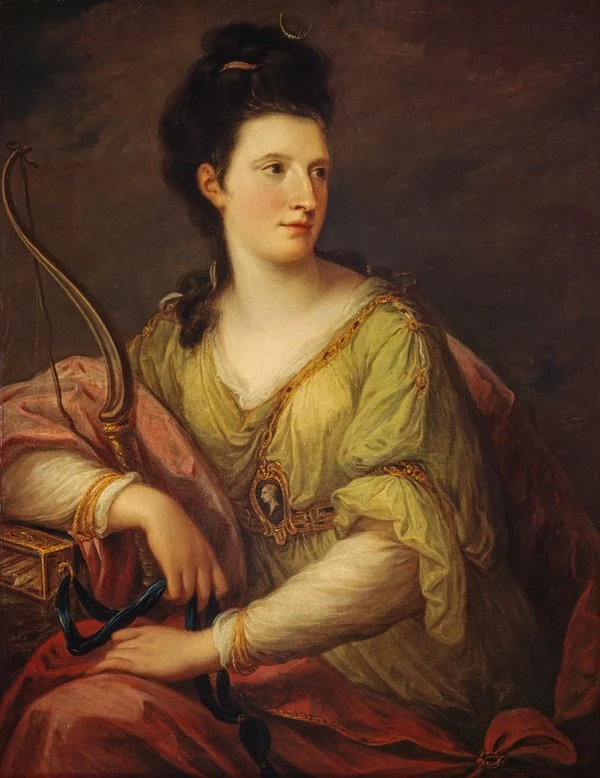
Angelica Kauffmann, Jane Maxwell, Duchess of Gordon, c. 1772, Scottish National Portrait Gallery, Edinburgh